
Description
Kirimahiga AA – Kenya
Kirimahiga AA comes from Murang'a, in the central highlands of Kenya, one of the country's historic coffee-growing regions. The plantations are spread across the slopes of the Aberdare mountain range, on deep, red volcanic soils, in a cool, humid environment. The washing station that gives the plot its name is located at approximately 1,700 meters above sea level, with annual rainfall of 1,200 to 1,400 mm and temperatures between 18 and 25 °C. The two rainy seasons support two production cycles: the main harvest linked to the rainfall from April to June and a secondary harvest associated with the rains of October and November.
Cooperative and producers
The Kirimahiga washing station belongs to the New Kiriti Farmers Cooperative Society, in the Mathioya district, about 200 kilometers north of Nairobi. The cooperative was registered in 1998, although coffee has been grown there since the 1960s, and has 1,595 registered members, 781 of whom are active. It manages three stations—Gondo, Kirimahiga, and Kayu—all in the Upper Midland region. The farms are smallholdings of around 0.25 acres, with an average of nearly 100 coffee trees, planted mainly with SL28, SL34, and Ruiru 11, the varieties that make up this lot.
Management is handled by a seven-member elected executive committee, with a three-person oversight committee that reviews operations and reports to producers at the Annual General Meeting. Day-to-day operations are managed by the head of administration, who oversees 19 permanent employees and an average of 25 seasonal workers.
Process
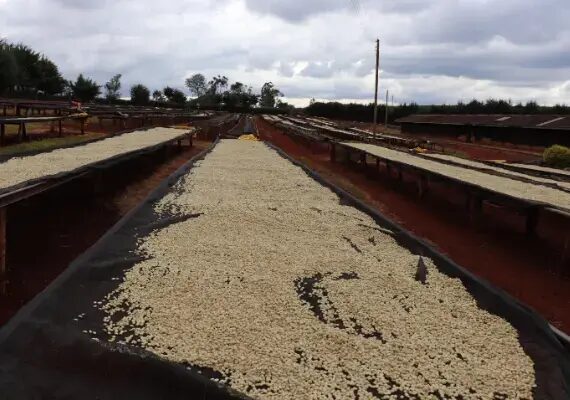
Harvesting is manual and selective, with the cherries arriving at the processing station the same day. Before pulping, the ripe, red cherries are separated by hand from the green, overripe, and foreign matter. The processing is wet, using clean water from the Gondo River. After pulping, the coffee undergoes controlled fermentation, followed by washing and a preparation phase before drying. Drying takes place in the sun on raised African drying beds, with the parchment being turned to ensure uniform drying. Once dry, the parchment coffee is sent to the dry mill, where grading and preparation are completed, resulting in AA grade coffee. The processing station recirculates the water used before directing it to evaporation and infiltration pits to minimize the environmental impact of the Kirimahiga AA wet processing method in Kenya.