Description
Green Planet — coffee from Honduras
Marcala is one of Honduras' most renowned coffee-growing regions. It lies in the mountainous Sierra de Montecillos, where coffee grows between 1,200 and 1,800 meters above sea level, almost always on small family farms and under shade.
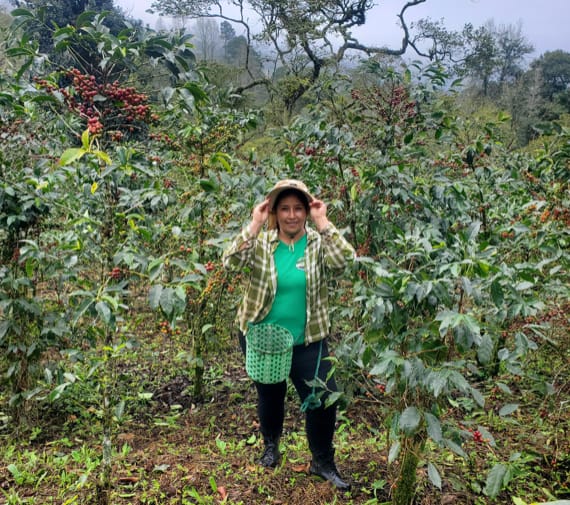
Planeta Verde is 1,600 meters away and leads to Karla Patricia Portillo, She is the third generation of a coffee-growing family. Her grandparents and parents worked coffee in the traditional way; in 2020 she decided to focus part of the production on specialty coffees, exploring what the farm and varieties could offer if management practices were refined.
For this micro-batch, work with Parainema and Icatú, Two varieties were chosen for how well they adapt to the farm's conditions. The coffee plantation is not alone: it coexists with guamo trees, avocados, sapotes, peaches, oranges, and timber trees.
The guamo trees provide shade and, when they bloom, attract bees and other pollinators. Woodpeckers, squirrels, rabbits, and agoutis also frequent the farm. Karla describes this as part of her production process, not as an addition to the coffee story.
Honduran coffee with anaerobic honey process
Once the coffee cherry is harvested, it undergoes a honey process with anaerobic fermentation. This method preserves some of the mucilage during drying and adds a controlled fermentation phase before completing the process.
In this case, the processing work complements coffee grown on a farm located at 1,600 meters, from two specific varieties and a plot cultivated under shade. It's not just about applying a technique after harvest, but about adding that processing to the work already done in the field.
Planeta Verde is, therefore, a Honduran coffee linked to a specific place and producer: Marcala, in the department of La Paz, and Karla Patricia Portillo. It's a microlot from Parainema and Icatú that reflects the transformation of a family farm towards specialty coffee without abandoning the traditional farming methods used for generations.