Description
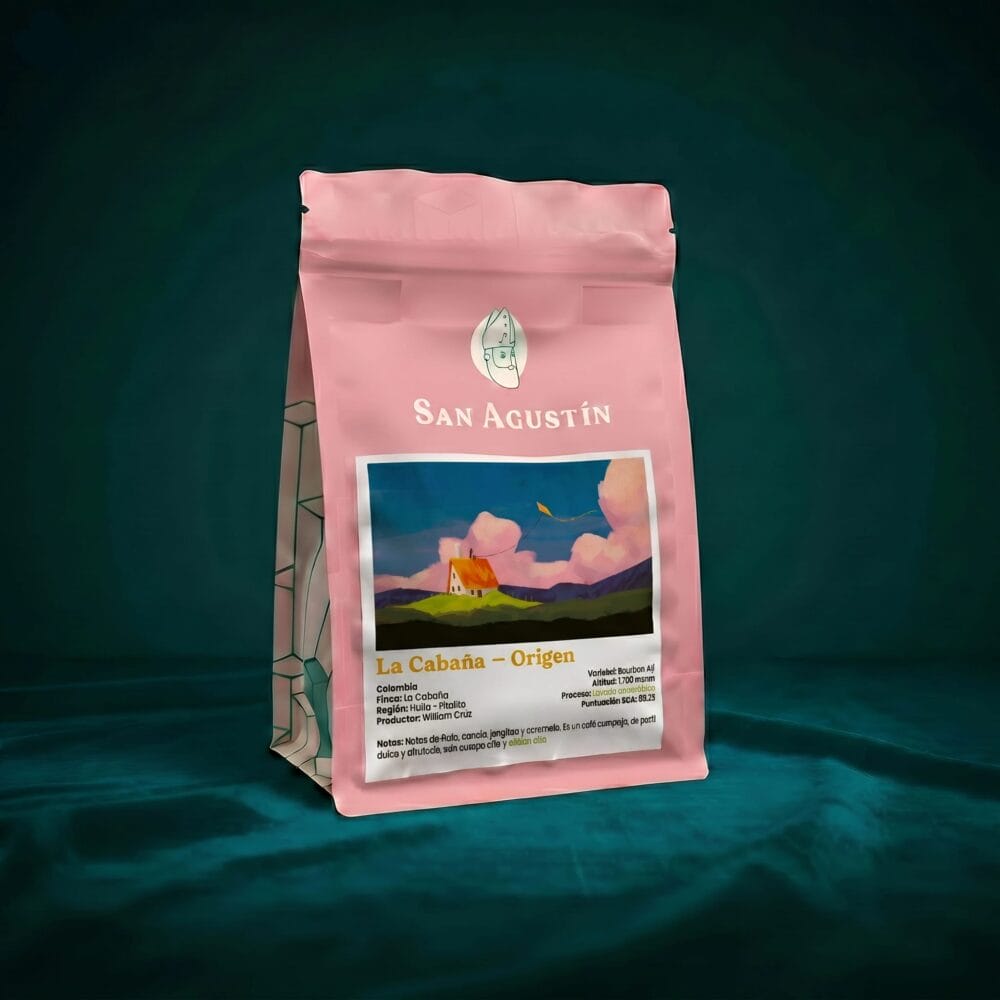
The Cabin – Origin
La Cabaña is located in Bruselas, in the upper part of Pitalito, where access is already difficult and the mountain sets the pace. At 1,700 meters, the fruit ripens slowly, without haste, and that's noticeable in the cup.
The farm is an inheritance. William Ortiz and his brother received it with conventional varieties, like almost everything else in the area. In 2016, they decided that wasn't enough. They educated themselves, tasted, and asked questions. They began uprooting the traditional varieties and planting what interested them—Bourbon Rosado, Ombligón, Pacamara, Bourbon Amarillo. Today, the farm's 90% vineyards are planted with exotic varieties. It wasn't quick or easy, but their direction never wavered.
William Ortiz
William grew up on the farm. That's not just a figure of speech: from a young age, working in the fields was part of his daily life. What changed over the years was his perspective—he stopped seeing coffee as a crop and began to see it as a process. Fermentation, varieties, ripening times, processing control. A method he built through trial and error, and trying again.
Today, they work with anaerobic fermentation and selective harvesting, and Finca La Cabaña has participated in several editions of the Cup of Excellence Colombia, always among the 30 finalists. This is no coincidence.
Processing. Dry washing
The ripe cherries are harvested and then floated in water to remove the less dense fruit. Next, the coffee is mechanically pulped and undergoes dry fermentation for 12 hours. After this stage, the coffee is rinsed twice with clean water and dried in the shade on drying racks for approximately 18 days, until it reaches its optimal moisture level.
San Agustín in origin
Finca La Cabaña is one of the estates we've been working with for some time. When we decided document the origin Of all our cafes, La Cabaña was the first stop.
We sent Nicolás Fernández (@nicocinq), an audiovisual producer based in Bogotá, to spend a few days with William. What he filmed is what you see below.
Huila
Huila is probably the Colombian department most associated with specialty coffee. The Central Mountain Range provides altitude, the volcanic soils contribute minerality, and the temperate climate with well-distributed rainfall does the rest. The farms here are mostly family-run, small to medium-sized, where everything is done by hand and attention to detail matters.
In recent years, Huila has also become a territory of experimentation—in processes, in varieties, in ways of understanding coffee. Cabaña Yellow Pacamara is part of that story.