Posted on - Leave a comment

Roasting Specialty Coffee: All the information is here. Now what?

I'd like to talk here—or rather, start talking here—let's put it this way—start talking about what's been on my mind these past few weeks. Share it with you and start a conversation.

It won't be about tips for barista routines or reviews of espressos I've tried lately.

It will be about information, competition, and the growth of the specialty coffee industry, in one area in particular – roasting.

As you probably know, I'm located in Lisbon, Portugal, which is just entering the specialty coffee world and becoming the birthplace of some new roasters.

Specialty coffee is going to be a boom here in the next two years, I dare say. To what extent—we don't know yet, as it depends on many factors. The quality of the coffee specialists on the scene, their internal motivations, their understanding of quality, of specialty for what it is, their palates, their ongoing training—and their ability to communicate all of this to their local customers.

All of these things influence the quality of the coffee roaster we'll have at the end of this period – will they be only local? Will they be known in Europe? Or, who knows, maybe the whole world, and for good reason?

And I focus primarily on coffee roasters, because for me, coffee should be viewed the way we view bread. We don't import bread from other places; we bake our own. Local roasters mirror the "state of the art" of specialty coffee, in my opinion, because on the one hand, it requires a deep understanding of coffee at every level, and on the other, it requires an understanding of the specific nature of local consumption. That kind of "union" between understanding the product and the consumer.

So my question is this.

A question for myself and for you. Fortunately, we're long gone from the days when coffee roasting was seen as a mystery, an artisanal process beyond our control, and for which you had to have a talent. Those were times when roasters hid their profiles (if they had one, of course) so no one else could replicate them.

This is in the past, like David Schomer's Barista Bible.

Now we meet at the roasting camps, sharing, learning, and talking.

What we have now is the opposite. It's the abundance of information. It's open, it's there, and you can take it. Just to give you an example, you can go on Google right now and check out the profiles of the World Coffee Roasting Championship. They can do it. There they are.

Books? Easy. Articles? In a matter of seconds. Want to learn about coffee chemistry? Barista techniques? Roasting strategies? Harvest calendars? No problem at all.

All this information exists, it's real, and sometimes it's free, other times it's not—but what's important is that it's available. You can easily pay a little money and take roasting courses or online courses with Scott Rao or Willem Boot. It will make you feel special, yes. If you're attentive, you'll take something for yourself. Like the thousands and thousands of other coffee specialists who took the same courses as you and who have read the same books.

So, what should we reasonably expect? Certainly, better espressos, because more baristas have discovered the refractometer. More developed roasts, because everyone now takes ROR into account.

So… let's assume it's happening. Roasts are becoming less so flat and end up getting sweeter and sweeter. Espressos are no longer so sour, and are now more complex and much more stable from barista to barista.

The question is…

 What is going to distinguish a toaster A from a toaster B?  They both bought the same machine, read the same books, took the same courses, have the same or similar coffee importer, and are trying to apply the same roasting strategy.

And now let's imagine the ideal situation, and suppose both roasters don't make the classic "mistakes"—like getting the coffee almost to the second crack, when it tastes burnt and smoky and loses all character, or flat roasts, or gourmet coffee that's presented as a specialty. None of that.

Why choose roaster A? Why choose roaster B? What's the difference between them at the end of the day?

Do those famous "background" factors come into play now more than before? Do we buy packages because they look pretty? Because they put pretty labels on the bags? Because it's blue (pink, black, gold, etc.)? Because we liked their Instagram? How do we decide which one is the best? Who's worth our money? Is it enough to simply "sell it right" for us to believe it's good? Are we really making informed decisions? Or do we, like the flock, follow the shepherd, follow whoever claims to be the best?

I was thinking about my choices. The toasters I love, the ones I'm curious about, and would like to try. I'm not a typical consumer, of course, but still...

There are categories of things I've tried only once, and then never tried again. I understood what I wanted to understand, and I didn't feel any connection, I didn't sense any personality, I didn't taste anything of that exceptional quality that I'd like to taste again. I tried it, and I left it.

There are some roasters who don't have a public image, at least not one I know, but after trying them, I felt the quality and honesty. I felt like they were buying quality coffee, and paying a price for it. I felt like they cared about how the final flavor would be. I remember them. And I'll shop there again if I want something solid to drink.

There's a third category of roasters: those who have a fixed image in my head. Those who have a personal story I believe in. I buy into the character. I buy into the image of the person leading the company, or roasting for that company. And, what's indicative, some roasters I like contradict one another. But what am I buying? I buy into a strong personal opinion, the courage to be different. I'm drawn to the values this person communicates; I'm drawn to integrity.

I guess that's my answer so far. We have the same information available, just reach out and take it, it's yours. Everything can be the same. Machines, packaging, origins, even the roasting style. So why buy from roaster B, and not A?

I was told last week that what can't be copied is style. I'll go further. I'll say it's integrity.

And it's a funny thing, it seems we've come full circle, and we've arrived back where it all began. Like the days when our grandparents bought coffee from local roasters they knew personally, now we buy beans freshly roasted by those we like, or with whom we identify.
Posted on - Leave a comment

"Bad Advice": Cata

When I was a kid, one of my favorite books was Bad Advice, basically reverse psychology for kids :), where the author gave you ideas on how to do the craziest things that would annoy your parents the most: like throwing breakfast out the window, or drawing on the walls, etc.

Beautiful book, by the way.

I've had a post in mind for a while, about the tasting routine. 

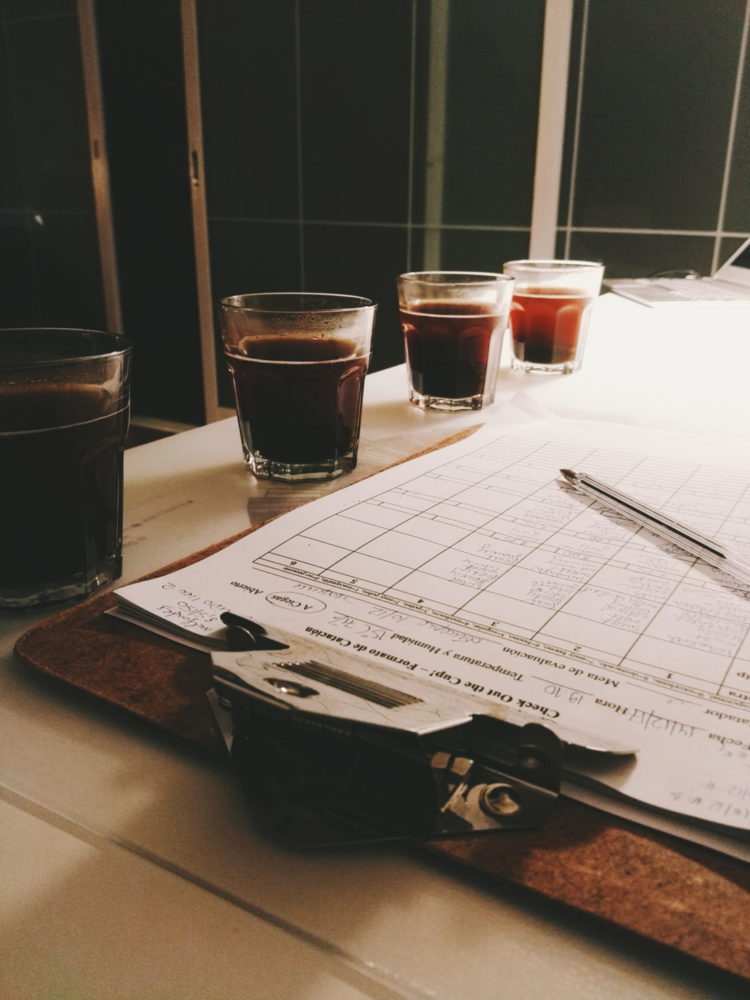
After all, cupping is a huge part of quality control in specialty coffee, whether you're a roaster, barista, or coffee shop owner, and it's also an incredible tool for self-education.

Cupping is a weekly procedure (sometimes even daily, in the best places), it is something simply necessary for the coffee shop to be considered a “specialty coffee shop”. There is no other tool that teaches you so much about the coffee you are serving and selling, that makes the baristas are more motivated and better understand customer needs.

Talking about bad advice and reverse psychology….

Here's a list of my personal tips, tested by my experience, on how to taste, but end up learning nothing from tasting:

  1. Don't weigh the water you put in the cups

That's a good one. You're very careful with the proportion while preparing a V60, so as not to pour in extra grams of water, and to make sure you are in the acceptable range (and I'm not even mentioning espresso – 43 grams and 35 grams are two different drinks!) – but of course, with cupping everything is different, and it's good to visually check that you are putting in enough water, and that way you are sure that all the coffees are in the same coffee/water ratio.

  1. Don't taste blindly

Open cupping is the best! Always try to take full advantage of the coffee information visible while cupping, so you can easily discover origins and flavor notes, and evaluate roasters and origins more highly when you have a preference. Be sure to include the beans for observation as well. If they have any visual defects, you'll be able to detect them in the flavor as well, without much trouble.

  1. Taste in a group of people, and share opinions immediately.

Cupping is best done in a group of people, preferably among coffee geeks. Discussing what you're experiencing and what you're thinking during the cupping will make you feel like you're on the same page and feel the same way about coffees as everyone else—and because of that, you're right. Eventually, you'll start to find the almond, tropical fruit, and sugarcane sweetness when you hear your friend's feelings.

  1. Don't take notes

Trust your memory completely, especially when it comes to materials like flavor descriptions. Of course, you'll remember exactly how the coffees you tasted throughout the month tasted, and you can always go back and double-check each coffee. Instead of taking notes, simply relax your mind, savor, and appreciate the moment.

  1. Avoid using numbers while evaluating parameters

It's a lot of work—trying to quantitatively formulate why this acidity is 7.5, and that body is 6.25. And after all, who really cares? No one's checking your grades, and we're not in school anymore. It's enough to note that this coffee has "good body" and "satisfactory acidity," and move on.

  1. If you are a roaster (coffee shop owner, barista, etc.): only taste your own coffees, never those of your competitors.

Why should you care? You're the best.

  1. Do not grind 2-3 grams of each coffee sample before grinding the cupping sample in order to clean the grinder.

There's no reason to do so, because, of course, there's no risk of contamination or mill retention. You can guarantee that in those 10 grams of washed Ethiopian coffee you're going to taste, all 10 grams are Ethiopian.

  1. Enter the tasting without any goal

Start the tasting without a clear goal in mind, and do it calmly, appreciating the coffees you taste one after another, their beauty and complexity, knowing that in an hour you'll forget everything and be ready to taste more tomorrow, with a clear head!

Posted on - Leave a comment

And now seriously… do we ever get to evaluate the taste of coffee?

Do we ever evaluate the taste of coffee?
Processed with VSCO with f1 preset

When I entered the coffee world—and I wouldn't say the specialty coffee world, because it was, as I see it now, low-quality coffee—when I entered, I knew nothing about varieties, origins, and processing.

And I was exploring. So I could easily try Sumatran coffee, or Indian Monsoon Malabar, or Jamaican Blue Mountain, or pay crazy money for the expensive geisha cafe, which didn't have any roasting dates. And a classic: going to Starbucks to check out their single origins.

And there was always a conflict. Because I couldn't taste the flavors written there in the tasting notes on the coffee bags.

But until recently, I pretended I could. (And I'm far from the only one who did!)

I now know that, as it was a low-quality coffee, and the roast was quite dark, it would not have been possible to taste the jasmine flowers in that old, rickety Geisha, nor the strawberries in the Monsoon Malabar.

But the labels said so. And I was insisting that I felt it. Probably, if I were more confident and honest with myself, I would have used the words "stale," "old," "paper." But no. I didn't have enough vocabulary, and I hadn't learned at that point to trust my receptors.

Only after a while did I get into the routine of tasting, begin to eat more consciously, expand my palate, and, over time, be able to taste more and more things. But it's a training process. And I'm not a "supertaster" of any kind. It's just a training process of learning how to put what you're feeling into words, and do it quickly and accurately.

And when I started getting into that tasting routine, it really made me realize how lazy my brain was. Every tasting became a battle against my brain's tremendous laziness, and it continues to be so to this day. Every time.

I realized that if I knew the roaster, or the origin, and I liked the previous experience, I tended to give higher scores. So I discovered almost immediately that it's mandatory to taste blind if you don't want your expectations to interfere.

I realized that if I like the flavor of coffee, I tend to also evaluate acidity and body more highly, and not analyze them carefully. I started to focus more on each parameter.

I realized that the packaging, the brand image, how expensive it is, my first impression of how much the company invested, will automatically make me rate the coffee higher. It will distract me from the flavor itself, because I'll make a connection between the packaging and quality. It also works the other way around: if I'm not impressed with the brand and the packaging, I may reduce the points when I'm tasting it. My brain is creating a connection that doesn't exist in reality.

And the list goes on and on; I'll write later about the tasting itself, which can be useful, as well as useless, if that topic interests you.

Right now, my questions are about something else.

I recently tasted a coffee, "X." In two different locations, the same coffee, within a one-month period. The tasting notes on the label say, let's say, "mango." But if you cup it, blind, you'll simply feel the roast. Burnt, toasty, charred, smoky—that's what I wrote on my cupping form while I was blind-tasting it. Twice.

So I'm not even saying it doesn't taste like mango, but it does taste like pineapple or hazelnut, and the tasting notes are inexact, but more or less close.

I'm saying there's no trace of specialty coffee quality in the coffee's flavor, and the only thing you can find is the flavor of the roast itself. There's not even the possibility of adding "nut" to it, because there are no nuts.

But then I saw several people writing about that particular coffee and repeating the “mango” story.

And I repeat, there is no doubt that this coffee has notes of "mango," because there is none.

So the reality is, once again, revealing. It means that many people who write about coffee, who write about food, don't take the time to taste. They're writing about flavors, but they don't trust their own sensations; they rely on someone else's misleading descriptions.

You don't have to be a real professional in sensory evaluation.

All of us, when we start tasting, start with very poor vocabulary and end up using only 6-10 descriptors.

We can't taste the "handle" yet, but we use the words "roasted," "smoky," "chocolatey," "fruity," "almondy," "citrusy," "floral": those general descriptions are enough—yes, they are ENOUGH—to make an honest assessment, in this case, of the coffee you're drinking. Yes, you won't look as smart as if you were writing "This coffee tastes of rose petals and amaretto liqueur, with some delicate notes of clementine peel"—you won't look as good, no.

But on the other hand, it's better to keep trying and give an honest description of the coffee you're drinking. Yes, it will be short, like "chocolate," "full-bodied," "balanced," but you won't put yourself in the foolish position of writing that it tastes like mango when the coffee is totally burnt.

And the descriptors will come with time. When you learn to connect what you feel with words. It will come. It always comes. You don't need any special talent for that. All you need is to keep practicing, stay connected to your sensations, and be impartial. It takes time, but it always comes.

That's all for now.

As always, I'm just trying to say that the time invested in mastering a skill is always worth it. And tasting is an essential skill in the food industry and, therefore, in specialty coffee.

In other words, don't be afraid to say, "You know, dude, I can't feel the handle."

Because chances are you're right.

Posted on - 1 Comment

"One, Two, Three, Fight!" or thoughts on the barista competition

Thoughts on the barista competition

I'm in danger of making this post seem a bit biased—and that's why I'm going to be very careful writing it. But I want to write it because this is the topic that truly excites me. It feels "alive," controversial, and that alone makes it worthwhile to try.

Before I begin writing, I have to confess that I have no experience as a competitor. Partly due to my personality; partly, and mostly, because I've been moving from one country to another in recent years. However, I do have experience on the other side of the scene—as a trainer for competitors and as a sensory judge, which makes me familiar with the protocol.

So, as you've probably already guessed, I'd like to delve into the world of barista competitions today, and think out loud, here with you, about what drives people to compete, what motivates them, what it gives back to the industry, and also mention a few facts that I find interesting.

People who compete have one big thing in common. And it's not about them being objectively the best in the industry. They all have the desire to win, to try, to find out who's the best—to compete, in other words. What I mean is, not all qualified professionals compete. The sample isn't representative, if you understand what I'm talking about. 

Basically, we find out who's the best among those who consider themselves the best in some way, and are willing to say it out loud. Those guys who aren't quite sure, those guys who don't have enough of a "competitor vibe," who don't want to put themselves on the map and shout about themselves out loud—they might be better baristas, more creative, more professional than some competitors, but they're not competing, so...

And here comes the most curious thing for me about the "barista department." I don't know about you, but most of the baristas I know, those I've worked with, those I've trained, those I've spoken to—are women. Most of the baristas you'll see in coffee shops are women. 

And now let's see one thing, the list of competitors for the 2019 World Barista Championship7. There are currently 50 registered competitors, and only 7 of them are women. 7 of 50. 14%. 2016: 61 competitors, 12 of them women. 19,67%. Women simply don't compete. Why? Is there something at the core of competition that makes it more attractive to men, and not women?

There's a study that says women are more focused on other values, like connection and communication, and competition just doesn't fit with that because it's disconnecting. I know many more male baristas who dream of competing, putting themselves on the scene, when sometimes objectively they're not as skilled as some of the female baristas. But they just don't hesitate, or the idea of competing excites them much more. I don't know. But I wish we could have more women entering the competition.

Competing, and especially winning the competition, is the best way to become known in the coffee scene – and eventually attract sponsors and offers. Goals of fame and money are the primary motivators for entering the competition. Which is fair enough; after all, we all have to pay the bills. What's disturbing to me is that when it becomes the sole motivator – aspirations are high, humility is zero, and it leads to cases like opening a barista school, talking about espresso, train people, charge money, and never, ever measure TDS in your life. That's a very real case, which is terrifying, but that's a different story.

I was thinking about that, and I guess that fame motivator is more active now in countries where the barista scene is developing. It's like the first step, the desire to be the best among the others, which is still close to the desire to be the big fish in the small pond. The bar isn't that high yet, and it's easier to get in and take some high places with a fairly simple presentation.

As the barista scene begins to develop, we see more and more people entering competitions with the goal of personal improvement. These include roasters, baristas, coffee shop owners, and managers. They use this opportunity to showcase themselves, yes, but at the same time, their place at the end isn't as important as the judges' feedback, and more importantly, everything they learned during the brewing process, which is a journey in itself to begin with. Competition opens the door to growth.

At the next level, competing is becoming a way to get the message across, the idea behind it, bringing something new to the industry, showing the results of experiments at each stage of coffee production, which could be coffee processing, variety (Sudan Rume and Sasa Sestic), new equipment (e.g. Canadian Ben Put using vacuum sealer), cafe operations (like using pre-ground coffee, like Charles Babinski from the US) or some crazy techniques (using frozen beans, like Kyle Ramage representing the US did this year).

This is the most exciting level, as it brings so much innovation to the industry and allows these ideas to reach more people, provoke more thought, give birth to new ideas, etc. For me, this is the most fruitful, the most interesting level and reason to compete—to add something new, to bring new ideas to the discussion. There are not many countries with this level of baristas; they are industry pioneers, such as the United States, Australia, Germany, Taiwan, and Japan, where there are a large number of competitors and regional championships.

The competition It's a challenge for the barista, a challenge to their skills, their creativity, their speed, their personality, despite everything. It's a challenge to put something bigger into their presentation than just a naked desire to win. Be inspired, driven, and walk away, no matter what position you took, with more ideas and knowledge than you had before you entered.