Description
Decaf from Nicaragua: Nueva Segovia
This decaf coffee from Nicaragua comes from Dipilto, in Nueva Segovia, in the north of the country, next to the border with Honduras. The farms there are small and grow coffee at altitudes between 1,100 and 1,400 metres. The lot combines coffee from several of them: Caturra, Catuai and Catimor.
Process
At origin, the producers process the coffee as washed. First they select the ripe cherries and put them through barrels of water to remove the ones that float. Then they pulp them without water and leave them to ferment for 25 to 34 hours, depending on the temperature that day. Finally, they wash them and go over them by hand on sieves. Then they dry them in the sun on mesh screens for 12 to 16 days.
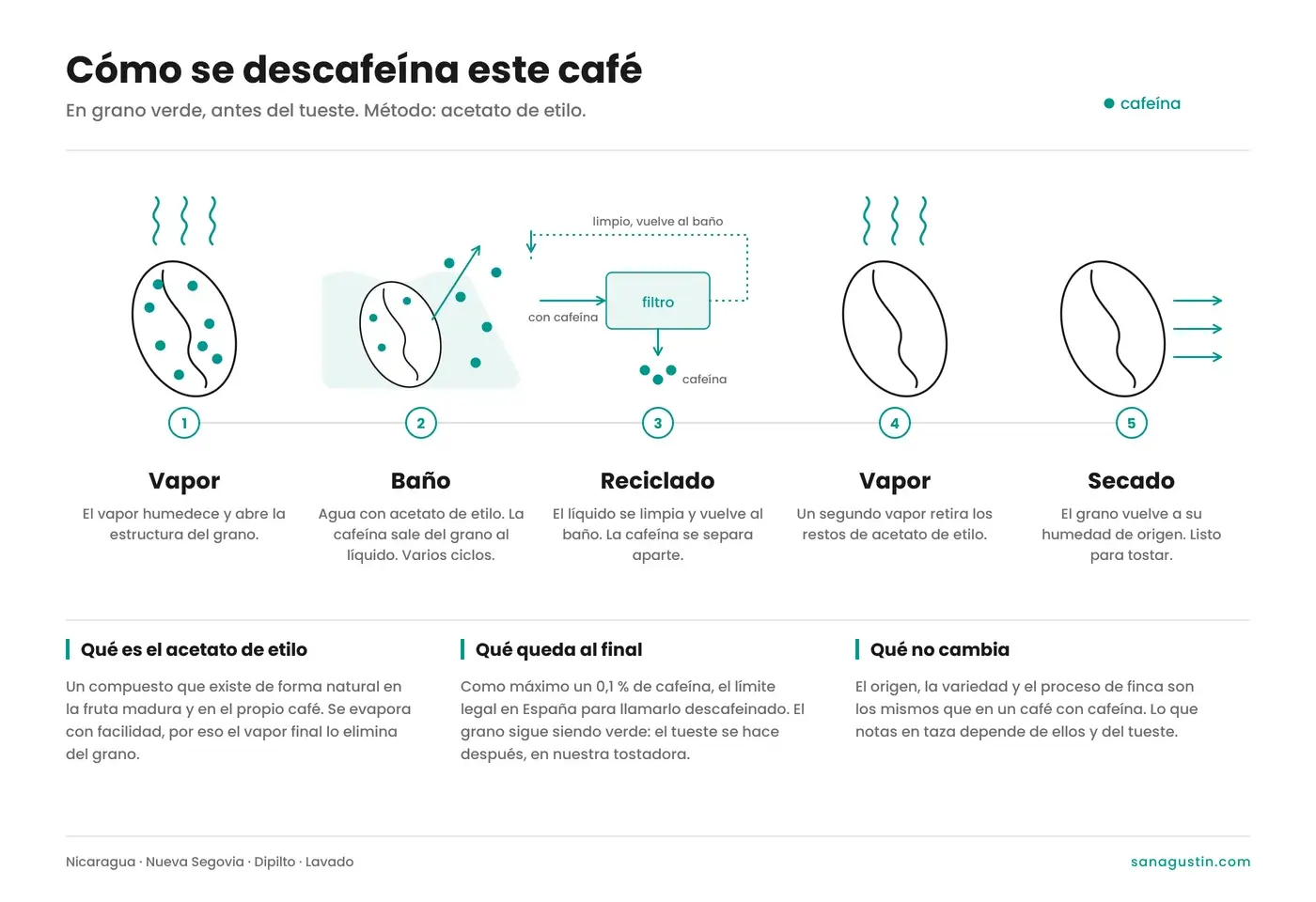
Once dry, the green coffee goes through decaffeination with ethyl acetate. First, steam opens up the bean. Then, several baths draw out the caffeine. Finally, drying returns the bean to its original moisture. All of this happens before roasting, as the chart shows.
What is ethyl acetate?
Ethyl acetate is a compound that occurs naturally in ripe fruit and in coffee itself. It also evaporates easily. For that reason, the final steam removes it from the bean before the coffee reaches our roaster. The plant cleans the solvent and reuses it in every cycle.
How much caffeine is left?
In Spain, the coffee quality standard only allows a roasted coffee to be called decaf if it has a maximum of 0.1% caffeine. This decaf from Nicaragua, Nueva Segovia, meets that limit. Therefore, it is a coffee intended for the afternoon and evening.
What doesn't change with decaf?
The origin, the varieties and the farm process are the same as in a caffeinated coffee. As a result, what you notice in the cup depends on Nueva Segovia, the producers of Dipilto and the roast. Decaffeination removes the caffeine; the rest of the work is still there.