Posted on - Leave a comment

Specialty Coffee: Where will being so geeky lead us?

It's been a month full of events and thoughts. And we're not even talking about the upcoming World Barista Championship, as everyone is waiting to see what will happen there in Amsterdam, who will make the final, and who will ultimately emerge as the champion.

True, right?

I had a "geeky" article
About water and coffee, ready to be published, but I'll put it on hold for a moment. However, I'll talk about water and coffee from another perspective.

I constantly feel like specialty coffee is becoming too "geeky." In a sense that "geeky" is different from being professional. So "geeky" that we're in danger of forgetting that coffee is like any other beverage or product. Like beer, wine, tea, whiskey, cheese, bread...

Coffee is as complex as any of these products. It is one of them. And while it feels good when you know what you're drinking or eating, and can distinguish the details and quality, it's not absolutely necessary for a good experience. It elevates your experience, yes, but only under one condition. When you are curious to know more about the product. Only in this case. In all other cases, knowing more about the product only irritates him.

How can you simply enjoy a good bourbonYou can enjoy a cup of coffee and then go on with your life, without going into the details of how it was fermented, harvested, grown, and knowing the names of all the workers who touched the cherries. It's not necessary.

I'm getting a little tired of the geeky stuff that leads nowhere.

I'll give you an example.
World Barista Championship
.

Geeks know that the water you use to make your coffee is very important. They know it needs to have certain levels of certain minerals to extract the coffee properly.

But what are they doing with that information?

They want everyone who makes coffee, no matter how professional, to use water with certain specifications. Because coffee must be roasted to the ideal water. If people don't have it, they have to buy filters, buy bottled water, look at the stickers, add minerals, etc. Do whatever they want, because water is important and everyone has to use good water to make good coffee. Period.

What this basically means is that they want a grandmother who buys coffee for her family Sunday lunch to be a geek over water. Or a super busy guy who needs coffee for fuel in the morning to do his v60 only with a certain type of water. Or a mother of three. I could go on, but you get the idea.

The truth is, not everyone wants to do it. Most people just want to drink coffee and get on with their lives. The roaster's job is to roast coffee for the most common water used, or for the recommended water that the customer can easily purchase. Not for a certain "ideal" water, which is unattainable for ordinary people and requires mineral stocks and additional investments, such as purchasing filters, etc.

That's why big brands thrive. Because they make it simple for the customer. And they're rewarded for it.

Information about water is valuable. It can give you, as a geek, almost superpowers.

Now that you're no longer blaming the roaster, you can take things a step further: "What if this coffee tastes flat because it was roasted for a different type of water?"

Do you see the difference?

Not "This coffee is poorly roasted" or "This coffee tastes bad because it doesn't work with my ideal water." But the question "What type of water was this coffee roasted for?"

Don't force the world to revolve around you, but use knowledge to your advantage.

Today I made a new coffee from a roaster I tried for the first time, with two waters. I made the first V60 with filtered and remineralized water, and it tasted sour and flat. Then I thought, "Okay, the guy's from here, so it's probably his idea to roast for tap water." I made a coffee with tap water, and it had a balanced, sweet flavor.

I think this is what being a coffee geek is all about. It's really about using knowledge and not pressuring the whole world to change because "they're wrong, they need to be educated about coffee."

I'm really in favor of that kind of thinking, that kind of growth as a professional. You need your knowledge to be able to follow the rules. And when you know how to follow the rules, you can think further and learn how to start breaking the rules and get even better results.

But keep in mind that not everyone who drinks coffee wants to be "polite."

If you're a coffee professional, having education and training in the field, especially during your early years, is crucial. For you. To serve better.

But being a coffee drinker in general is a different story. Just like you're not asked for a license when you're about to enjoy your whiskey, beer, or tea. You just do it. And it's the job of cheese/beer/whiskey makers (and coffee makers among them) to make it accessible and easy for you to enjoy their product.
Posted on - Leave a comment

"Extract everything": proportions in espresso

"Extract everything": proportions in espresso
.

The ideal coffee/water ratio for espresso is a never-ending story and always raises many questions.

I had my doubts about whether I'm the best person to write about this, basically because I stick to two rules in all my coffee activities.

The first rule is "Measure everything." Literally. And the second is "Experiment, even if what you're trying to do looks weird." Actually, those are the two reasons why I shake the V60. Yeah, no shame :)

Or maybe this actually makes me a good person for trying to think about proportions… Who knows. But I'll try.

I confess that for a second I thought about being a “know-it-all” and writing a lot of letters, showing you a lot of super complicated graphs, and making a very long and, of course, very informative article (or even a series of articles!) with a lot of definitions and numbers, and with the brewing chart, of course – but I prefer to be honest with you and instead of all that, share with you a little secret that is not a secret at all :)

Everything (and I mean EVERYTHING) written after June 2015 that discusses espresso extraction and recipes for beginners and mid-level baristas is, or will be, inspired by these posts by Matt Perger on the Barista Hustle (Dose, Strength, Yield, Time, Altogether).

The information has been out there for two years, and it's the kind of information that opens your eyes, organizes everything you want to know about how to "build" an espresso from scratch, and leaves you with a clear head and a huge desire to go out and pull those espressos "like a boss." I tend to give the last video, about putting it all together, to new baristas, when they're ready to enter the world of ratios. 

I'd like to talk about espresso ratios here, about my preferences, but since I'm using some tactics I learned from Barista Hustle in adjusting my espresso – first, I'll put it briefly here, so we're on the same page.

The important detail here is that this system works even if you don't have a refractometer. Yes, it's better to have one, yes, numbers are much more reliable than your taste buds—but what can I say? It's time to train our taste buds. 

In my opinion, it's necessary to be able to taste an espresso, and to say what's wrong with it, and how to solve the problem. A kind of understanding of the reasons, what I call "sensory imagination."How could it be better, and what can I do to make it better?Does espresso need more body? Do I want more clarity? More complexity?

Start in this order: first set the dose (dry coffee), then the desired amount of espresso in the cup, and as the last step – the shot time.

Choose and lock the coffee dose in the portafilter, according to the amount of coffee you intend to make and the size of the baskets you are using in your portafilters.

Use weight (not volume!) to measure espresso.

You decide which style of espresso you prefer—or, in other words, what you're more willing to compromise on: extraction or strength—and then choose the performance you want.

And that's it. Hurray! (Then, of course, you apply every possible and impossible adjustment to improve the uniformity of your extraction.)

So… Why am I the wrong person to talk about ratios? … Because it’s all good to me :) Do you like your espresso short, intense, and full-bodied, something around 11-12% Tds? It’s all good to me. Do you like a sweet, delicate espresso, and don’t mind losing some texture while gaining complexity? Is 8-9% your go-to? Sounds great!

As long as you know what you're doing, and why, and who your customer is, what they want, and whether they're getting what they want – you're going to be in complete control, staying on top of your espresso game.

And whether it’s 8% or 12%, or even 7% is your choice – the truth is that we are in the world of flavor, and your short extracted coffee can have an interesting flavor, and also as a lungo it can gain some complexity and be different: study your customer and study their coffee and then choose what is best for you. 

There's no right or wrong; there's only your informed choices and your performance. Right and wrong can lie in the barista's technique or approach. But what can be wrong with a barista's technique?

What I'm not a fan of at all is overdosing to under-extract espresso, to mask flaws in the roasting technique or the barista's work, and eventually all those triple ristrettos. When you learn, from your own experience or someone else's, how much work goes into harvesting, processing, transporting, and roasting the coffee, it's almost physically painful to use 21 grams in the basket to extract 21.

Oh really. 

That's why I'm on the side of extracting maximum flavor from the minimum dry dose. And that idea of manipulating espresso flow that we learned before—that to extract less you should grind coarser or put more coffee in the basket—needs to change. We should stop using the dose to manipulate the flow, because we end up wasting more coffee, and actually understanding less about it. So, if you want to extract less, you have to grind coarser.

Regarding proportions, the line of thinking I am suggesting is this:

First, consider the style of espresso your customers are looking for. What is the espresso For them? What are they used to? A short, bitter substance drunk like medicine? Or do they allow for a little more flavor?

Then explore how your coffee works with that ratio.It has a good flavor extracted shortIs it interesting and sweet enough to be extracted for a little longer?

Consider the number of milk-based drinks you're making, and if it's a significant number, calculate the milk-to-espresso ratio you're using. If your drinks are long, it makes much more sense to also use long espressos. Otherwise, the coffee will suffocate in all that milk. If you primarily serve short espressos and cappuccinos, you can use a short espresso as a base to maintain the balance between milk and coffee.

As I told you at the beginning, for me working with coffee is a beautiful combination of being free from experiment and measure everything at the same time. And it applies to espresso ratios in the same way.

Yes, you must know the rules, measure the extraction, the TDSUsing the flat tamper, the right baskets, consistent tamping—basically, finding every way to constantly improve your technique with the goal of improving consistency and extraction. But what comes next is also your job, as a barista: figuring out how your coffee tastes best, and how to deliver that espresso repeatedly.

The truth is, there are no rules that tell you "always do it this way." And if someone tells you the ratio should always be 2.2 or 1.5, don't believe them. There are too many factors at play (roast level, days after roasting, variety and processing, the style of espresso you'd like to achieve, cultural factors in the country where you're drinking it, etc.) to be able to create such a strict rule and insist on it.

So, I think there's no point in searching for it. Instead, take a deep breath and immerse yourself in the search for espresso. Be free to experiment. And measure everything! :)

Posted on - 1 Comment

"Tell me if you freeze it..." – or on the cool side of coffee

Tell me if you freeze it

Hello, hello! Good afternoon, everyone.

First of all, I have to introduce myself, because I am a new face here, in this space of San Agustín CafesMy name is Liza. I've been in the specialty coffee world since 2012 as a barista, and since 2015 as a coffee roaster. Among many other things, I'm fortunate to have worked roasting for a specialty coffee chain in my home country.

I now live and work in Lisbon, Portugal, and have been blogging about coffee for some time now. "Coffee Without Lies"Here I'd like to share with you—if you find it interesting, of course—my random thoughts about specialty coffee, the industry, and simply the delicious (or not so delicious) espressos I'm lucky enough to try.

If you ask me to point out a trend in the coffee world that has made the most noise in recent years, sparked the most discussions, motivated people to experiment, and in the end, in almost all cases, has easily integrated into the daily routine of coffee professionals and enthusiasts – I'm going to say "freezing."

I use the word "trend" because it's something relatively recent – but I clearly remember an episode in my life that happened about 3 years ago.

My boss and I were on a trip to a farm and were visiting one of the coffee professionals I admire and highly respect—roaster, farm owner, trainer, judge (and many other things)—and she invited us to have coffee at her cafe.

We chose the beans (it was Pacamara Natural, but correct me if I'm wrong) – and then in front of us, the barista opened the freezer, took out the beans, measured the necessary amount… We couldn't believe our eyes. We've heard many times before how bad it is. Never do it, it's an absolute no-no – and here she is, using the frozen beans for the AeroPress we ordered. We asked her if she finds freezing a good way to store beans. She said, "Absolutely yes, I do for a long time."

We were sitting outside, looking at the mountains, enjoying the cool breeze, literally hundreds of meters from the coffee plantations. Of course, we didn't expect that AeroPress to taste good. After all, who would? We silently agreed not to say anything out loud out of respect, but... I mean, really? It seemed like a joke! Specialty coffee in the freezer?

Needless to say, the barista brought it, and it tasted good. Frozen coffee. It tasted. Good. Yes, an AeroPress made from frozen beans stored in non-airtight bags—it tasted better than acceptable.

It surprised us. We haven't adopted the practice, but let's just say it opened our minds after that.

Personally, I started freezing months after this. Not for practical reasons, really. At the time, I was living in Central America, and someone brought me Caballero Catuai from Tim Wendelboe. I had to stock up on it because I wanted to enjoy it longer. Considering that in that part of the world, I was getting coffee roasted outside the country, specifically—from Europe, specifically—from Tim Wendelboe.

So I froze it.

It was my first attempt. I bought those special bags and a hand pump, which I found, luckily for me, at the supermarket next door. I measured the doses I use for V60 at home, and froze the coffee, dosed like that, in 15-gram bags. I froze the necessary dose so as not to have to go through the extra effort of opening an entire bag, removing the coffee, and freezing it again. I read (I think it was Matt Perger) that it makes more sense to do it that way. And I put it in the freezer, hoping for the best. Honestly, because the coffee was fantastic, and I was risking everything by putting it in there to freeze.

To cut a long story short, don't use hand pumps if you want to be taken seriously in the world of coffee freezing :) Some of the bags weren't sealed properly and burst open. Of course, they absorbed all the smells from the fridge, absorbed moisture, and the coffee in the cup was unpleasant. Others survived. And I became able to do something that sounds pretty crazy: enjoy a cup of magnificent coffee from Tim Wendelboe in Central America, months and months after the roast date, while it continued to be delicious.

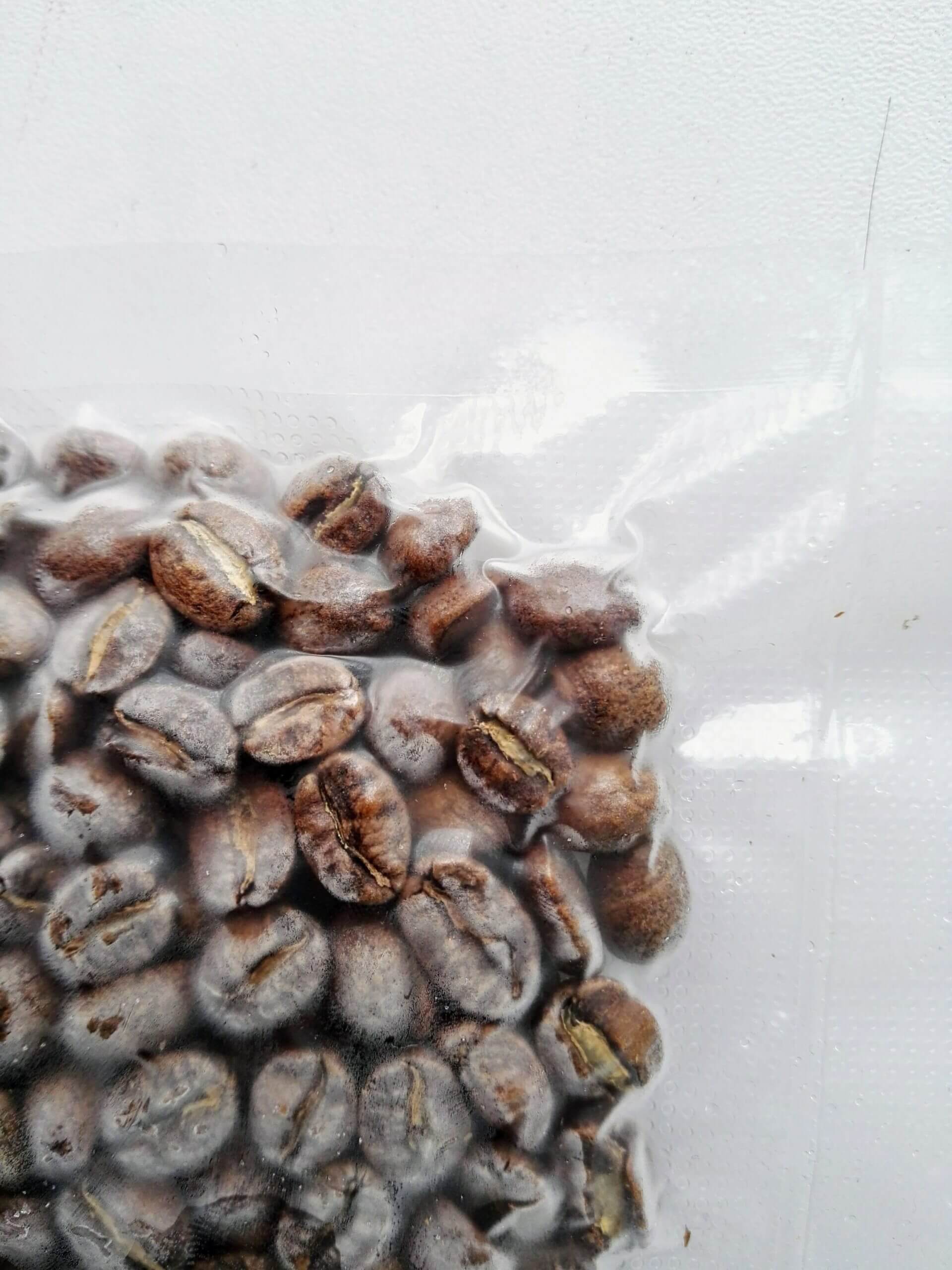
My routine now no longer includes a hand pump, but it does include freezing the vacuum-packed beans.

And here we have, in a nutshell, a simple way to significantly slow the aging of coffee beans, without worrying about changing the coffee-to-water ratio, grind size, or brewing method based on how long it's been since the roast date. Do it exactly the same way you did the first time. Months after the roast date.

To mention other benefits of freezing: better particle distribution, less coffee "dust" that leads to over-extraction, and a cleaner, shinier cup at the end. Even better than before freezing.

Necessary equipment? Vacuum sealer + special bags. Exactly the ones chefs use to package food when cooking sous-vide. They're very popular right now, and you can easily get them for less than 100 euros, and if you can keep an eye out for promotions, even less than 50 euros.

Freezing coffee in vacuum bags has become part of my routine now, whether I'm getting new coffee and don't want it to go stale too quickly, knowing I won't drink it all at once, or when I want to have a bunch of samples to taste, or when I'm roasting and want to keep comparing different batches… In all cases, you're no longer playing against time. I think it's worth spending some money on.

It remains to be seen whether it works as well with ground coffee as it does with whole beans. Probably yes, if the coffee is frozen first, then removed, ground, vacuum-sealed, and refrozen in portions... There's a whole field to experiment with, I'm just thinking out loud...