Posted on - Leave a comment

Once again on the water issue

Once again on the water issue

What is the right water for making coffee?
What water are you preparing it with?

I've been facing a lot of coffee superstitions lately, or some kind of beliefs, and the topics related to water for making coffee are the ones that generate the most questions.

Questions and doubts about water that are winning:

  • The battle of the "correct" coffee recipes for different methods (Coffee recipes aren't set in stone; it's good to experiment, not just repeat after someone else. They have a different coffee, different water, a different grinder – why repeat? Hoping it will work anyway?))
  •  the idea that roasting for espresso should be darker ((only if you want it that way or for some reason you got used to it, but it is definitely not mandatory),
  • and the question "Why does coffee taste salty?" (because it is under-extracted).

And yet, among all of these, the water issue continues to create a lot of confusion.


To name a few: some people defend their position that the softer the water, the fewer minerals it has, the better it is for making coffee (question: “Why not use distilled water?” It has none at all, so I guess the coffee will taste better?).


Some people opt for alkaline water, believing that a higher pH contributes positively to the flavor of coffee prepared with that water.


Maxwell Colonna-Dashwood and Christopher H. Hendon have already addressed the topic of water in coffee in their book, Water for Coffee: a must-read for those interested in the subject, focusing on how water works and what elements contribute to coffee flavor and how. Consult this book if you want to understand why low-mineralization water isn't the best choice for making coffee, and why coffee water shouldn't have a pH of around 9 or 5.

The truth is that coffee lovers around the world continue to search for the best water for making coffee.

So… What is the right water for making coffee?

I'll answer this question from the perspective of a roaster and coffee drinker, leaving aside the "coffee geek" (being a coffee geek is useless...).

The right water for brewing a particular coffee from a particular roaster is the water that roaster uses to taste their coffee when looking for the roast profile. Period.


You may ask me why.

Why can't I use water "X" because I consider it to be the best water for making coffee?

Or “Y” water which is very soft?

Or “Z” water that…


The truth is that you can.

And if you've learned enough about water and what contributes to coffee extraction, you can even make your own water with ingredients you can easily buy at the pharmacy. It's all fine, really, as long as you don't claim that only this particular water is suitable.

But there is one important detail, no matter what water you choose to use.

There is already water involved. Before you even brew the coffee you get, that coffee has already been tested. With a particular water. The roaster was cupping it with a certain water, and was guided by the results of that cupping, looking for a specific roast profile. He, intentionally or subconsciously, tuned the coffee to the particular water.

And that will be the best water to drink that coffee, whether you want it or not.

Roasted coffee is always roasted to a specific water temperature, and it would make life much easier, and coffee drinkers more satisfied, if that idea had been communicated more widely. Every bag of coffee you've ever bought was roasted to the water temperature the roaster uses at the location where they cup the coffees. Whether the coffee is from Sweden, Norway, Denmark, the United States, or Germany, each of them is water-roasted in their cupping rooms.

It's probably happened to you before. You bought a coffee from a beloved roaster, opened the bag, brewed it at home... And you weren't impressed, or rather, disappointed?

Most likely it's because the water you used and the water the coffee was roasted in were dramatically different.

The message I want to convey with this post is simple. Buying locally roasted coffee, aside from the benefit of fresh roasting, has an additional benefit, hidden from public view, but ultimately even more important. Local roasters probably roast for local water. They roast for the water you have at home.

What does this mean in practice? You can literally make your coffee with tap water and get wonderful results.

So… What water are you making your coffee with?
Posted on - Leave a comment

Cold Brew Miracle

Imagine: You're a specialty coffee lover and you buy a 250g bag for 10 euros.

How would you make this coffee? Would you use 40 grams, wait 24 hours, and have enough concentrate to make 2-3 cups, or could you make a V60 from 15 grams of coffee? Which will give you 220 grams of highly caffeinated liquid in the next 4 minutes? :)

Cold Brew Miracle

Has it ever happened to you? You're tasting a coffee, and immediately thinking, "It tastes good, but that would be just as amazing as a cold brew! I have to make a cold brew

Has this ever happened to you? No? Me neither.

And if you think about it, it's a little strange.

Sometimes you drink a coffee like an espresso, and then you get curious and want to savor it through the filter. Or you drink a coffee and immediately think about how you're going to make it. V60? Aeropress? Espresso? You're asking yourself those endless, yet so dear to the heart of every coffee lover, questions: "What do I want to enhance? The smoothness of the body? Notes of red fruits? The delicacy? How do I make this coffee reach its full potential?"

But it never happens that in that line of coffee brewing methods to choose from, you have a cold brew.

And if cold brew is just a method of making coffee, that's pretty unfair.

But… what if it’s something more?

Let's dive into the topic for a moment.

When I say “cold brew” in this post, I’m referring to immersion cold brew, which is by far the most popular method of cold brewing.

There is also Kyoto-style cold brew, where the coffee is brewed in a special glass "tower" and water slowly drips through the coffee, literally drop by drop.

Kyoto-style cold brew, like probably most Japanese devices, is more of an art than anything else, and the visual aspect is simply spectacular!

It's also a fairly expensive device, which at the same time doesn't produce much liquid, so it's not often used for producing cold brew in large quantities. However, for those who love making coffee at home, there are options that cost around 25 euros, making Kyoto-style cold brew a fairly affordable option.

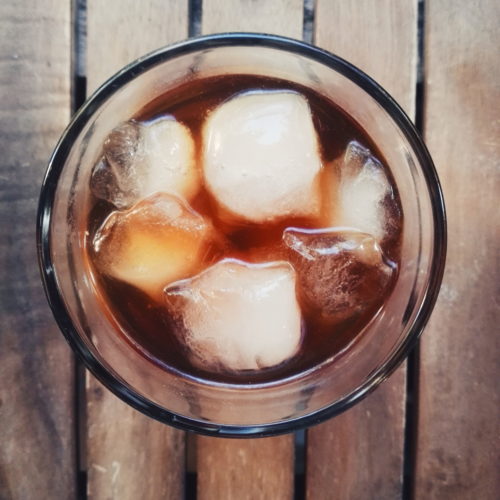
The most popular cold brew preparation method is immersion. It involves mixing medium-coarse ground coffee with cold or room-temperature water, then letting it sit at room temperature. As with any recipe, you're free to experiment with brewing times, grind size, and ratio. The most popular ratios are 6:1 or 7:1 water:coffee.

After 18-24 hours of steeping, filter the coffee concentrate and store it. Then you're free to do anything with it, depending on how much you want to dilute it.

Cold brew coffee concentrate gives you a great deal of freedom in blending and making the final beverage, which can be literally anything: cold brew, hot brew, iced coffee, latte, coffee-based cocktails, etc.

From this point of view, cold brew coffee is extremely versatile.

So let's go back to where we started.

Why isn't cold brew in line with all the others, like espresso, V60, Chemex, etc.?

The main question is this: Is cold brew a standalone coffee brewing method, or is it simply a tool?

I won't jump to any crazy conclusions here, but I'll walk you through the strengths and weaknesses of cold brew.

+ CB is extremely versatile and can be a base for many coffee drinks and cocktails

– CB does not have as intense a “coffee flavor” as espresso, therefore it has a tendency to get “lost” in cocktails

+ Speaking of cold brews, working with CB is easier than with iced filter coffee, because you don't need to calculate the ice melting, and because the concentrate you use is already cold.

– Although you don’t have to calculate ice melting when making cold brew, it would be best to use the refractometer at least when creating the recipe, to achieve a desirable TDS, and to know how the concentrate you are creating behaves with ice and milk when served.

+ the cold preparation can be prepared in advance, stored in the refrigerator, and easily served throughout the week

– Making a batch of cold brew takes 18 to 24 hours. Compared to the usual 2-4 minutes to make a filter and experiment with grind size, 24 hours seems like a long time to wait only to discover you've done something wrong. And if you're out of cold brew, you're really out. It will really take a while to make more.

+ It generally has a smooth, easy-drinking profile without pronounced acidity or bitterness, making it an easy sell to people who don't like coffee with a strong personality, and prefer something more delicate.

– One drawback of cold brew being bland is exactly what some people consider a positive side of cold brew: the drink lacks character, compared to the same coffee prepared another way.

– High ratios. You have to use a lot of coffee, and not very efficiently. So, if you don't own a roaster or have free coffee, making cold brew ends up being quite expensive.

+ The positive side of this is that roasters often use cold brew to “move” the coffee and give it a second life.

– Under control of the extraction. Basically, you choose the recipe, grind size, and steeping length, and wait to see what happens. You can't control much, especially if the location where you're steeping is subject to temperature and humidity fluctuations.

To put it all together, cold brew is the best thing to do if you want to use up some extra coffee you already have that's getting old. It's a good way to prepare coffee "in advance" and store it, or even freeze it, and ultimately save some time on brewing. It's a great thing to do if you like smooth, delicate coffee.

And summer. Summer is the perfect time for cold brew :)